

Introduction
Located in the middle of the stunning landscape of Tibet, Yam Dwar is more than just a gate towards Kailash Mansarovar; it is also known as the gateway between the mortal and sacred world of Mount Kailash, which is also known as the home of lord Shiva. This sacred site is also known as the gateway of the lord of death, as translated from its name. Yama or Yam is the god of death who judges right and wrong in one’s life, and “war” literally translates to the gate. But what we just said is just a small glimpse into the various aspects of Yam Dwar. And, if you are someone who wants to know more about this stunning and spiritual place, then you have come to the right place, as here we shall provide you with information such as these and more.
In this blog, we provide you with various aspects of Yam Dwar, such as the location of Yam Dwar, the spiritual significance of Yam Dwar, and the journey from Yam Dwar to Mount Kailash. In addition to this, we shall also provide you with additional information, such as the mystery behind the Tibetan flags, the top things to do in this place, and Yam Dwar altitude in its challenges. So, keeping this in mind, let’s get started!
Location Of Yam Dwar
Source: Instagram Sacred Walks
The first thing that we shall discuss here is the location of Yam Dwar. This place is located in Tarboche, which is located in Darchen, in the Autonomous region of Tibet. Yam Dwar lies at the foothills of sacred Mount Kailash, and it serves as the official gateway for the revered Kailash Parikrama. The Yam Dwar is located approximately 4,724 meters above sea level and is surrounded by breathtaking landscapes with snow-capped peaks and vast Tibetan plateaus, which enhance its spiritual aura. The site is not only a significant stop for Hindu devotees but also holds deep religious importance for Buddhists, Jains, and Bon followers, each associating it with their own sacred beliefs. Furthermore, pilgrims also symbolically leave behind their worldly attachments to seek divine blessings before embarking on the challenging trek around Mount Kailash.
Spiritual Significance Of Yam Dwar
As mentioned previously, this location is associated with the lord of death and gate, which combine to form the meaning of “Gateway to the God of Death”. As you can expect from a location with such deep meaning, the location has a deep spiritual significance. Starting with the name itself, Yama, whom the location is named after, is the god of death and is believed to stand as the guardian of the portal. Therefore, it is believed that passing through this location, this gate signifies the transition from the world to the divine world of Lord Shiva. Passing through this gate is also considered an act of surrender where you, as a pilgrim, detach from worldly ties and prepare for spiritual purification.
Besides this, the Buddhists also consider this place to be a place that is associated with Tarboche. Tarboche is a sacred flagpole that represents the Buddhist cycle of life and rebirth. For Buddhists, the site is believed to be blessed by Guru Rinpoche. Likewise, in Jainism, Mount Kailash, which is nearby, is regarded as the Ashtapada, which is a place where the first Tirthankara, Rishabhdev, attained liberation. Thus, crossing Yam Dwar signifies stepping into the world of spiritual awakening and self-actualization.
In Bon religion, which is a religion that predates Buddhism in Tibet, the region around the Yam Dwar is considered sacred as it symbolizes the entrance to a cosmic journey that connects the divine and mundane.
Journey From Yam Dwar To Mount Kailash
Following the spiritual aspect of Yam Dwar, let’s also talk about the journey from Yam Dwar to Mount Kailash. That said, we should not discount that this journey is indeed a spiritual one. The entire journey takes roughly 52 kilometres and is traditionally completed in three days. The general outline of the three-day journey from Yam Dwar to Mount Kailash includes the following:
Day 1: Yam Dwar to Dirapuk (approx. 12 km)
After traversing Yam Dwar, pilgrims make their way to Dirapuk Monastery, located at 5,080 meters (16,666 feet). The terrain here is dotted with breathtaking vistas of Mount Kailash’s north face, which is usually considered the holiest view of the pilgrimage. The terrain is typically gradual but increases in steepness as one approaches Dirapuk, where numerous overnight here.
Day 2: Dirapuk to Zuthulpuk through Dolma La Pass (About 22 km)
The second day is the toughest, with pilgrims trekking over the Dolma La Pass, the highest point on the trek at 5,645 meters (18,520 feet). The pass is so named after Goddess Dolma (Tara), who is said to bless and protect travelers. Pilgrims walk past Gauri Kund, a holy lake connected with Goddess Parvati, along the way. The trek down from Dolma La is rocky and steep to Zuthulpuk Monastery, where most pilgrims overnight.
Day 3: Zuthulpuk to Darchen (around 12 km)
The final aspect of this journey takes you from Zuthulphuk to Darchen, which is relatively easier as it features a gentle descent towards Darchen, which is the base of the town near Mount Kailash. You complete your Kora on this day after feeling spiritually renewed and blessed by the divine presence of Lord Shiva.
The Mystery Behind Tibetan Flags At Yam Dwar

Source: Amar Ujala
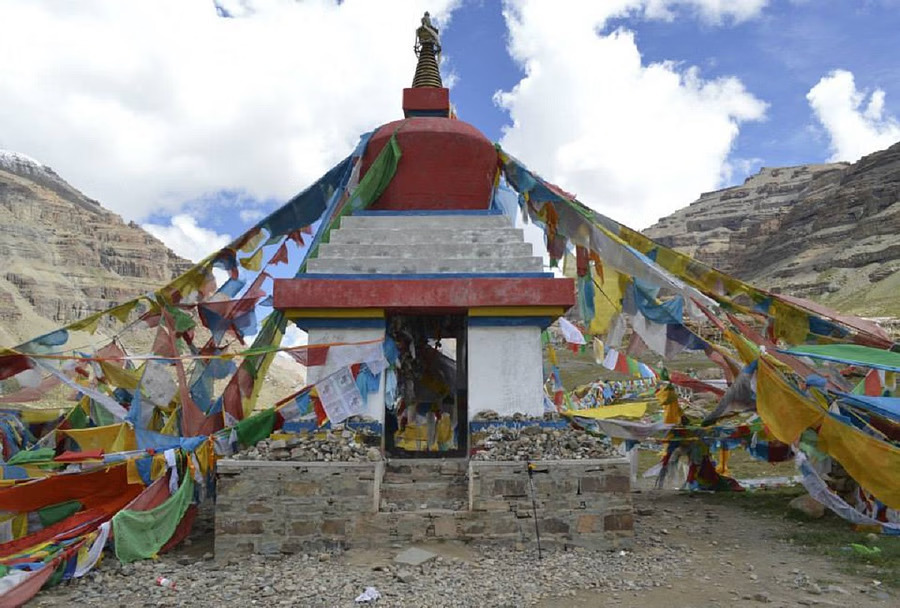
Now, sticking with the spiritual theme, as the journey is a spiritual aspect, let’s also discuss one of the key aspects of this location, i.e., the mystery behind the Tibetan Flags at Yam Dwar. If you look up this location, you can find plenty of prayer flags around this location, and these flags are deeply rooted in Tibetan Buddhist traditions. Each of these flags also holds deep spiritual significance. Following are various aspects regarding the mysteries associated with the Tibetan flags at the Yam Dwar.
1. Prayer Flags That Move Without The Wind
One of the most common and reported mysteries associated with the prayer flags is that they flutter without the wind. Rather, specific prayer flags flutter while others do not flutter at all. This is a rather unexplained phenomenon, and it is believed to be a spiritual sign, suggesting the presence of unseen forces that can be either guiding or testing you.
2. Sudden Changes in Color and Disappearance
Another mysterious phenomenon associated with prayer flags in Yam Dwar is the sudden changes in the color of the flags and the random disappearance of the flags. Although natural exposure to elements can wear down the colour, it takes multiple years. Monks believe that the changes in colour and disappearance are caused by interference in the spiritual world. That said, this phenomenon does have somewhat of a scientific explanation as it suggests that this phenomenon is caused by the high altitude and spiritual ambience causing temporary visual hallucinations.
3. The Whispering Wind
While the previous entry was visual, this one is auditory as the pilgrims believe that when you reach this place, you can feel an eerie sensation as if the prayer flags are whispering. Many people believe that these whispers carry messages from divine beings, with the scientific explanation being the same as our previous entry, i.e., hallucination caused by high altitude and spiritual ambiance.
Top Things To Do In Yam Dwar
Going back to the physical aspects, let’s now talk about the things you can do at Yam Dwar. Since this is a tourist destination, this place must have things you can do, right? Yes, there are. You can do a wide range of activities, most of which are spiritual. Some of the key things you can do at Yam Dwar include the following:
1. Offer prayers and mantras.
Yam Dwar is of great spiritual significance and a perfect place at which to offer prayers and chant mantras before starting the Kailash Parikrama. Pilgrims who offer obeisance would typically pray to chant “Om Namah Shivaya” (to Shiva) or Buddhist mantras like “Om Mani Padme Hum”, wishing them good luck and purification.
2. Knot prayer flags
One of the most meaningful activities at Yam Dwar is the tying of Tibetan prayer flags, which are believed to carry prayers to heaven. Pilgrims tie their own, typically writing names and desires before tying them at the location. The flags represent forsaking attachment to the world and taking refuge in God.
3. Perform prostrations
Certain pious pilgrims even do full-body prostrations in a sacrificial gesture of humility and piety. The majority of Tibetan Buddhists, especially, do them on the premise that every prostration washes off past karma from them and brings them one step closer to enlightenment. Still, others undertake the complete Mount Kailash Parikrama on continual prostrations.
4. Engage in rituals
Yam Dwar remains normally packed with monks, sadhus, and pilgrims performing sacred rituals. Incense sticks are ignited, prayers are offered, or special mantras are recited by spiritual gurus. These rituals enhance the spiritual bond to Lord Shiva and the divine energies of Mount Kailash.
Yam Dwar Altitude And Its Challenges
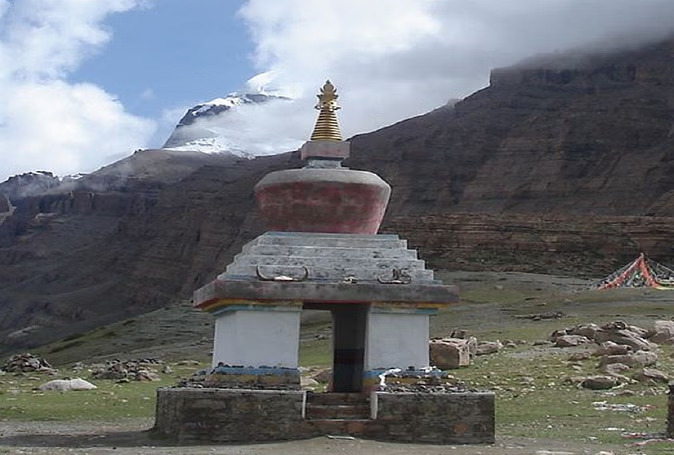

Source: Amarujala
Sticking with the theme of physical aspects, let’s also talk about the altitude and the challenges in this location. Since Yam Dwar is essentially a gateway to Mount Kailash, it is not a surprise that it is located at a higher place. This palace is located at around 4,724 meters, which is rather high. Although the oxygen is not 50% less, as you may find in locations 5,000 meters above sea level, it gets rather close. Because of this, you may face some challenges when visiting or passing through this location. Some of the key challenges include:
- High Altitude: Low oxygen levels make breathing difficult.
- Altitude Sickness: Risk of AMS, causing headaches, nausea, and dizziness.
- Harsh Weather: Sudden temperature drops, strong winds, and occasional snowfall.
- Physical Strain: Walking and climbing feel exhausting due to the thin air.
- Need for Acclimatization: Lack of proper adjustment can make the journey dangerous.
- Remote Location: Limited medical facilities and emergency support.
- Spiritual and Mental Endurance: The journey tests devotion, patience, and inner strength.
- Steep and Uneven Terrain: Walking through rocky paths can be physically demanding.
- Limited Resting Spots: Few shelters or places to rest before the Kailash Parikrama.
- Dehydration Risk: Cold temperatures reduce thirst, but staying hydrated is crucial.
- Strong Spiritual Energy: Some pilgrims report feeling overwhelmed or lightheaded.
- Language Barrier: Communication can be difficult for those unfamiliar with Tibetan or Chinese.
- Strict Travel Regulations: Permits and guided tours are mandatory, limiting flexibility.
- Isolation: Lack of mobile network and connectivity can make communication difficult.
How To Reach Yam Dwar
So at this point, we have discussed some spiritual aspects, some geographical aspects, and some physical aspects regarding Yam Dwar. However, we still haven’t talked about how to reach this place. So, how can you reach Yam Dwar? Well, you can reach Yam Dwar by either air or road. Following is a brief description of these two methods:
1. Air
The nearest airport to Yam Dwar is Tribhuvan International Airport (TIA) in Kathmandu, Nepal. Tourists then usually fly from there to Ngari Gunsa Airport (Ali Airport) in Tibet, the nearest airport to Mount Kailash. Flights are rare, and pilgrims take the road route.
2. Road Trip
Besides travelling by air, another method of reaching Yam Dwar is by road, which is the more popular route of the two. Although the specific route can and does vary depending on the package, the following are the common routes followed on road trips to this location:
- Kathmandu to Syabrubesi: Drive (approximately 7-8 hours) to the Nepal-Tibet border.
- Syabrubesi to Kerung: Drive along the edge of Tibet to Kerung (2-3 hours).
- Kerung to Saga: Long drive (about 8-9 hours) across the Tibetan plateau.
- Saga to Darchen: Another day’s travel (7-8 hours) to the foot of Mount Kailash.
- Darchen to Yam Dwar: Drive a short distance (30-40 minutes) from Darchen.
Distances from Yam Dwar
Following the theme of location, let us also talk about the distances of Yam Dwar to some key places around Mount Kailash. Whether you are visiting from close by Darchen or you are on a long trip from Kathmandu, every visit provides you with your own special challenges and adventurous experiences. Thus, keeping this in mind, some of the distances from Yam Dwar to key places are:
- Darchen to Yam Dwar: ~7 km (~30-40 minutes drive)
- Saga to Yam Dwar: ~500 km (~8-9 hours of drive)
- Kerung to Yam Dwar: ~700 km (~2-3 days, including acclimatization breaks)
- Ngari Gunsa Airport to Yam Dwar: ~220 km (~4-5 hours of drive)
- Kathmandu to Yam Dwar (by road): ~900 km (~4-5 days with stops)
Best Time To Visit Yam Dwar
The other significant detail that we haven’t yet talked about is the most convenient time to visit Yam Dwar. Well, the specific duration depends on your expertise, but for general people, the ideal time is between May and September. During this period, the weather is relatively safe, and the pilgrimage routes remain accessible. During this period, the daytime temperatures are mild, which makes trekking more manageable. Apart from this, the roads are also safer, and landslides and snow blockades are less common. Additionally, this period of the year also overlaps with Saga Dawa, which is a Tibetan Buddhist holiday.
Conversely, traveling between October and April is not recommended due to extreme winter conditions, below-freezing temperatures, and heavy snowfall, which will make the journey very arduous. To ensure a spiritually rewarding and secure experience, plan to go in the warmer season.
Must-Know Tips For Indian Pilgrims Traveling To Yam Dwar
As we are nearing the end of our topic regarding Yam Dwar, let us share some pilgrim tips for visiting Yam Dwar. A few of the tips are as follows:
- Obtain Necessary Permits: A Chinese visa and Tibet Travel Permit, reserved via authorized tour operators, are obligatory for visiting Tibet.
- Join a Guided Tour: Solo travel is not allowed; Indian pilgrims must make reservations through authorized agencies.
- Acclimatize: Spend a few days in high-altitude areas like Darchen to avoid altitude sickness.
- Pack well: Carry warm clothing, trekking shoes, AMS medication, and energy snacks.
- Have Indian Money & Chinese Ren: Exchange small cash in Nepal or Tibet as ATMs can be difficult to access.
- Respect Local Culture: Respect Tibetan culture, do not touch religious objects and obey the photography ban.
- Food Available: Indian vegetarian food is available in groups, though it is recommended to bring ready-to-eat foods.
- Drink Ample Water & No Alcohol. Drink plenty of water for acclimatization.
Common Problems And Their Solutions
The final thing that we will cover here is some of the typical issues and their resolution on how to overcome them. So, you can face many problems, but some of the typical big ones and how you can resolve them include:
- High Altitude & AMS: Walk slowly, drink plenty of water, and take altitude sickness medication if necessary.
- Extreme Weather: Layered clothing, thermal underwear, and waterproof equipment.
- Language Barrier: Learn some basic Tibetan or Chinese language or stay with your guide for language.
- Remote Location & Limited Facilities: Carry essential medicines, power banks, and hygienic products as medical facilities are limited.
- Long & Arduous Journey: Prepare yourself physically and mentally for bad roads and long travel hours.
- Rough Travel Laws: Obey all government and permit rules so that there is no issue at the border checkposts.
Conclusion
Yam Dwar is a deeply spiritual location, which is also known as the gateway of the lord of death and has deep spiritual significance in a wide range of religions. Furthermore, there is also a wide range of spiritual and mystical aspects attached to Yam Dwar. Now, there are many ways to reach this gate, but the two most popular ways are airways and roadways.
In this blog, we provide you with various aspects of Yam Dwar, including its spiritual aspects and geographical aspects, in addition to essential tips and common challenges. We hope this was helpful. For information on other aspects of trekking, please read some of our other blogs. And if you want to know which is the best company to take you to Yam Dwar, you need to look no further than Kailash Vision Treks. Thanks for reading thus far.